Why Your CRM Is the Wrong Tool for Fire & Life Safety Compliance
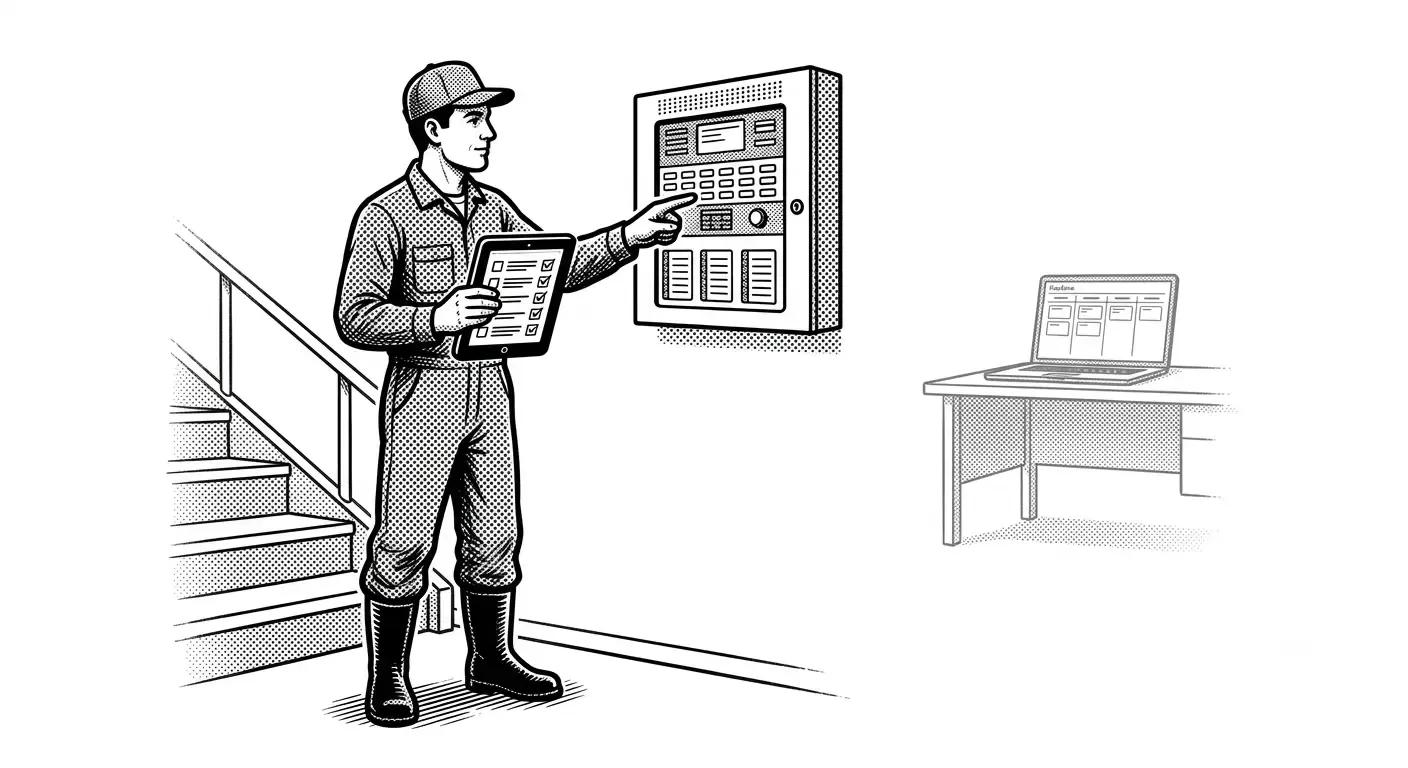
A generic CRM will let you close a deal, log a call, and move a card across a pipeline. What it won’t do is tell you that the sprinkler valve behind Door 12 is six weeks overdue for its annual internal inspection, or format that inspection’s results the way your local fire marshal’s office actually wants to receive them. That’s a sign the tool was built for a different job, not a missing feature you can bolt on later.
Key Takeaways
- Generic CRMs treat every job the same, so they can’t automatically flag a specific asset as overdue against its own code-driven inspection cycle.
- Notes and photo fields in a CRM aren’t structured around individual assets, so defect evidence becomes hard to find later.
- Reporting to a local Authority Having Jurisdiction (AHJ) is often a separate, jurisdiction-specific format problem a CRM has no concept of. Third-party ITM reporting portals are used in at least 37 states.
- When paperwork doesn’t hold up, the consequences are concrete: real municipal citations and insurance disputes turn on whether inspection records exist and are current.
Your CRM Doesn’t Know What “Overdue” Means for a Specific Asset
A generic CRM’s idea of a due date is whatever you type into a due-date field on a task. It has no built-in concept that a portable extinguisher needs a monthly visual check and an annual maintenance visit under NFPA 10, while a dry-pipe valve fifty feet away needs an annual internal inspection under NFPA 25 — two different assets, two different clocks, in the same building. Salesforce’s own Field Service Guide found that technicians lose 18% of their working hours, more than 7 hours a week, to administrative tasks like filling out forms and hunting for information, in a survey of 6,500 service professionals globally (Salesforce Field Service Guide, 4th edition). A separate Salesforce report found 52% of service organizations still rely on manual or paper-based reporting (Salesforce State of Service, 7th edition). Neither number is fire-industry-specific, but both show what happens when software can’t track a recurring, asset-specific obligation on its own: a human has to remember it instead.
Checklists and Photos Get Disconnected From the Asset They Belong To
Ask a technician to attach a photo of a corroded sprinkler head to “the job” in a generic CRM, and it lands in a notes field or an attachment list tied to that day’s visit, not to the sprinkler head itself, permanently. BuildOps, a fire-vertical field service platform, names this exact gap: crews can’t reliably find past photos, proposals, or signed inspection forms because generic CRM note fields aren’t structured around individual devices, which makes it hard for a manager to review compliance work after the fact (BuildOps, “5 Best CRM for Fire Safety Teams”). A year later, when someone asks “what did the panel inside that access door look like the last three times we opened it,” the answer depends on whoever happens to remember which job that was.
Offline Fieldwork Breaks Generic Mobile Apps
Fire and life safety inspection work happens in basements, electrical rooms, and stairwells, exactly the places cell signal doesn’t reach. As one fire-vertical software vendor puts it, if a field app doesn’t work without a signal, it doesn’t work for this trade at all (BuildOps, “Best Fire Inspection Software”). Most general-purpose CRMs are built assuming a live connection to sync data as it’s entered. When that assumption breaks in a mechanical room, the fallback is a paper checklist that gets typed up later — reintroducing the exact manual re-entry step the software was supposed to remove.
Reporting to the Authority Having Jurisdiction Is a Different Job Than Reporting to Your Own Business
Once an inspection is done, many jurisdictions require the results to be submitted through a separate, government-facing system: a third-party ITM (inspection, testing, and maintenance) reporting platform used by the local Authority Having Jurisdiction (AHJ), not just filed in the contractor’s own records. The National Fire Sprinkler Association documents this landscape directly: third-party ITM reporting is used in at least 37 states, with fee structures that vary by jurisdiction: per-site, per-riser, per-fire-pump, or per-page, with no standardization (NFSA, “Digital Third-Party ITM Reporting of Fire Protection Systems”).
The practical effect compounds fast. A business working across a few adjacent counties can face several different mandated reporting portals, each wanting the same inspection data in a different format. The data gets entered once for the contractor’s own records, and again, differently, for every jurisdiction involved. NFSA notes that metro areas with overlapping jurisdictions multiply this further, and that many ITM-reporting portals don’t even track follow-up on flagged deficiencies once they’re submitted (NFSA, “Fire Sprinkler Inspections: Considerations for ITM Reporting”). NFSA also raises a data-security angle: uploading reports to third-party portals can expose contract pricing or client details to public-records requests if the platform doesn’t segment that data properly. It’s a compliance-specific risk a generic CRM was never designed to manage.
That AHJ reporting has become specialized enough to spawn its own software category is itself evidence of the mismatch. BRYCER’s Compliance Engine, one AHJ-facing compliance platform, states it’s used across more than 2,000 jurisdictions in the US (a vendor-reported figure, not independently audited) — a scale that only makes sense if generic business software genuinely can’t do this job.
When the Paperwork Doesn’t Hold Up, It’s Not Just an Admin Problem
The consequences of a missing or lapsed inspection record aren’t hypothetical. In January 2025, a property in Seattle was cited and fined $746 for a fire protection system’s inspection, testing, and maintenance not being completed, a matter of public record (Seattle Municipal Court Hearing Examiner, Case #37372). It’s a single case, not an industry-wide rate, but it’s real and checkable, and it shows what’s at stake: incomplete records create exposure with a regulator, not just confusion inside the business.
Insurance is the other side of that exposure. NFPA 25 sets a floor for how long inspection records must be kept, but Fire Testing Solutions notes that insurance carriers commonly expect around five years of records on hand, and that “Protective Safeguards” endorsements can let an insurer deny a fire-loss claim if a required safeguard, a sprinkler system, for instance, wasn’t demonstrably kept in working order (Fire Testing Solutions, “Why Insurers Reject Claims”). Whether or not a specific claim goes that way, the records that would answer the question either exist and are easy to produce, or they don’t.
What Fire and Life Safety Businesses Actually Need Instead
This work needs software where the asset — not the job, not the deal, not the ticket — is the unit everything else attaches to.
| What’s needed | What a generic CRM does instead |
|---|---|
| Inspection cadence tied to each asset’s own code-driven cycle | A generic due-date field a human has to set and remember |
| Photos and defect notes attached permanently to the asset | Attachments tied to a single job or deal record |
| Field capture that works with no signal | An app built assuming a live connection |
| Reporting formatted for the AHJ that actually requires it | One generic PDF export, regardless of jurisdiction |
This is the gap Quri is built to close for fire and life safety trade businesses specifically: asset-first record-keeping instead of a generic CRM stretched to cover work it wasn’t designed for. If you want the deeper architectural case for why the underlying data model matters this much, we’ve written about that separately in Asset-Based vs. Job-Based.
Your CRM isn’t bad software. It’s good at pipelines, deals, and customer relationships in general. Recurring, code-driven, jurisdiction-reported compliance work is a different job, and it deserves software built for it.